
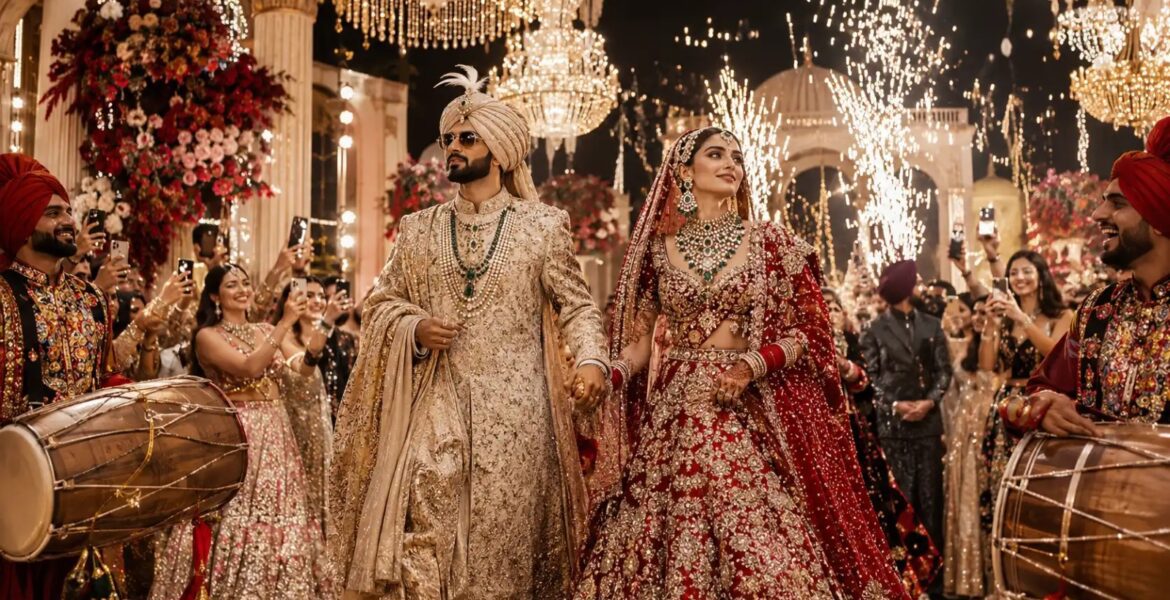
From extravagant wedding venues and celebrity performances to designer couture and curated guest lists, the Punjabi wedding has evolved into a spectacle of unprecedented proportions. But amidst the grandeur, are we still celebrating love, or are we increasingly competing for the most expensive version of it?
“So, I’m getting married!”
A friend called me recently with the news, and naturally, I was delighted. There was excitement, a little squealing, and the inevitable exchange of questions about the date, outfits, and the celebrations. And then came the detail that made me pause.
“We’re getting married at XYZ,” she announced. “You know, our common friend got married at that other five-star property last year. I really didn’t want the same venue. This one is much more expensive, and honestly, the wedding deserves something bigger.”
For a moment, I wondered whether I had been invited to witness a love story or an elaborate real-estate competition.
Welcome to the modern Punjabi wedding, where the question is no longer simply when are you getting married? But increasingly where are you getting married, who is performing, what are you wearing, and, perhaps most importantly, how much are you spending?
Punjab has always known how to celebrate. Weddings here are not merely ceremonies; they are emotional extravaganzas, deeply woven into the region’s cultural identity. The dhol, the gidda, the bhangra, the jaggo, the kaleere, the chooda ceremony and the infectious enthusiasm of an entire family coming together are traditions that deserve to be cherished. There is an unmistakable warmth in the way Punjabis welcome guests, feed them, dance with them and make every occasion feel larger than life.
But somewhere between preserving tradition and pursuing perfection, the Punjabi wedding appears to have developed an entirely different aspiration: outdoing the last one.
The contemporary Punjabi wedding is, in many ways, a carefully orchestrated production. There is a venue reveal, a designer outfit announcement, a celebrity performance, a spectacular entry, elaborate floral installations, drone shows, personalised hampers and, of course, a photographer ensuring that not a single moment escapes Instagram.
Even the celebrations have acquired a competitive vocabulary. A destination wedding is no longer extraordinary simply because it is a destination wedding. It must be somewhere more exclusive. A designer lehenga is not enough; it must be a couture creation that nobody else has worn. A celebrity’s appearance is impressive until someone else’s wedding features a bigger name.
The result? A celebration that increasingly resembles a social scoreboard.
The irony is that many of these decisions are not necessarily driven by the couple’s personal preferences. They are influenced by what a cousin did last winter, what a neighbour organised last month, or what someone from the extended family posted on social media. The wedding becomes a statement to be made, a standard to be surpassed, and, sometimes, a rather expensive answer to an imaginary competition.
And the audience? It is no longer restricted to 500 people attending the festivities. It includes thousands of people watching Instagram stories, judging the décor, counting the functions, and assessing the scale of the celebration.
Celebrity weddings have undoubtedly amplified our appetite for spectacles. They have transformed the wedding industry, influencing everything from designer bridal couture and decor aesthetics to destination choices and entertainment.
Consider Anant Ambani and Radhika Merchant’s wedding celebrations in 2024. With performances by international artists, including Rihanna and Justin Bieber, a Mediterranean cruise, extraordinary floral installations and a global guest list, the celebrations became an international talking point. It was a remarkable display of wealth, influence, and meticulous event production. Naturally, it also raised questions about extravagance and the increasingly blurred boundaries between a private celebration and a public spectacle.
Priyanka Chopra and Nick Jonas’s wedding at Umaid Bhawan Palace, Jodhpur, in 2018 offered another spectacular example. With Hindu and Christian ceremonies, elaborate Sabyasachi couture, multiple celebrations and a distinctly multicultural aesthetic, their wedding became an aspirational reference for couples across the world.
Deepika Padukone and Ranveer Singh’s Lake Como wedding, also in 2018, demonstrated how luxury could coexist with cultural authenticity. The couple honoured both their Konkani and Sindhi-Punjabi traditions through separate ceremonies, creating an intimate yet visually extraordinary celebration.
And then there was Anushka Sharma and Virat Kohli. Their Tuscan wedding in 2017, attended by close family and friends, proved that a luxurious destination need not translate into an overwhelming guest list or an endless calendar of functions.
These weddings represent different interpretations of grandeur. Some are monumental spectacles; others are intimate affairs set against extraordinary backdrops. Yet perhaps the most important distinction is that a celebrity wedding is not a universal template. It is a personal choice, shaped by individual circumstances and preferences.
The problem begins when aspirational inspiration turns into an obligation to replicate.
Behind the shimmering chandeliers, imported flowers and designer ensembles lies a less glamorous reality: the cost of Punjabi weddings.
For some, the celebrations are comfortably within their means. For others, the desire to maintain social standing can translate into borrowing, exhausting savings or spending years of accumulated wealth on a few days of festivities.
There is also a curious phenomenon of the wedding guest list. How many people are genuinely there to bless the couple, and how many have been invited because their presence is considered important to the family’s social standing? In some circles, the absence of an influential acquaintance becomes a bigger talking point than the presence of the people who matter most.
Even the bride and groom can find themselves playing supporting roles in an event supposedly organised in their honour. They move from one photograph to another, from one designer ensemble to the next, often following an exhaustive schedule. The celebrations are magnificent, but do the people getting married actually get a moment to enjoy them?
Perhaps we have become so preoccupied with documenting the wedding that we have forgotten to experience it.
None of this is to suggest that Punjabi weddings should surrender their flamboyance. Their exuberance is part of their charm. There is nothing wrong with an extravagant venue, a spectacular bridal ensemble, a world-class performer or a celebration that lasts an entire week.
Luxury, after all, is not the enemy. Compulsion is. There is something profoundly beautiful about a father watching his daughter walk towards a new chapter, a grandmother blessing the couple, childhood friends dancing without choreography, and families coming together despite years of geographical distance. These are moments no floral installation can manufacture, and no celebrity performance can replace.
Perhaps the real measure of a wedding should not be the number of crores spent, the celebrity who performed or the exclusivity of the venue. It should be the memories that survive long after the lights are switched off and the last guest has departed.
So, the next time someone announces their wedding plans, perhaps we should be more interested in asking how happy they are rather than how lavishly they intend to celebrate.
Because a marriage is not a competition, and a wedding is certainly not a balance sheet of social success.
The big fat Punjabi wedding can remain big, beautiful, colourful and unapologetically extravagant. But it would be lovely if it could also remain a little less about proving a point and a little more about making a promise.
After all, the most expensive thing about a wedding should never be the need to impress everyone. It should be the privilege of finding someone with whom you want to spend the rest of your life.