
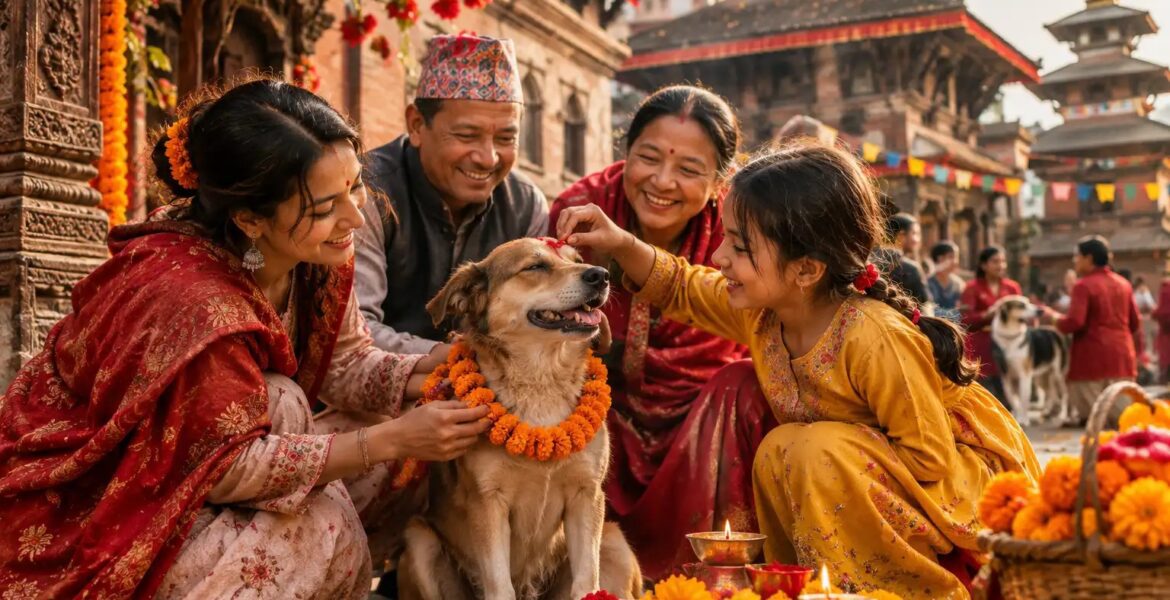
In Nepal’s luminous five-day celebration of Tihar, dogs step out of the margins and into the centre of devotion. More than a charming spectacle, Kukur Tihar offers a quietly radical lesson in reverence, loyalty and the obligations of love.
Picture a Kathmandu Lane in November. The air carries the fragrance of marigolds and incense; doorways glow with oil lamps, and the city seems to have exchanged its ordinary rhythm for something gentler. At the centre of this festive theatre comes an unlikely guest of honour: a dog. Perhaps he is a household pet, freshly bathed and mildly bewildered by commotion. Perhaps he is a familiar street dog, usually negotiating traffic and chance encounters. Today, both are welcomed with flowers, food, and an unmistakable measure of tenderness.
A marigold garland is placed around the dog’s neck. A vermilion tika is pressed gently onto his forehead. A generous meal follows. There are no auditions for affection, no pedigree papers to produce, and no distinction between the pampered and the pavement-wise. For one day, the dog is not merely tolerated in the human world; he is honoured by it.
This is Kukur Tihar, Nepal’s much-loved festival of dogs, celebrated on the second day of the five-day Tihar festivities. The word kukur means dog in Nepali, and the ritual is at once devotional, celebratory and deeply intimate. Across homes and neighbourhoods, people offer dogs flower garlands, tika and food, acknowledging the companionship and service they have given humankind.
The custom forms part of a larger celebration that honours animals and relationships. Crows, dogs, cows, and oxen receive their own days of recognition, while the festivities conclude with Bhai Tika, celebrating the bond between siblings. It is this remarkable cultural philosophy that makes the dog festival in Nepal so distinctive: gratitude is not reserved exclusively for human relationships.
It is tempting to call Kukur Tihar a picturesque celebration, a delightful cultural curiosity tailor-made for photographs. But reducing it to a photogenic parade would mean overlooking its spiritual significance. This is not simply a day for dressing up dogs. It is a ritual of gratitude, rooted in a worldview in which the animal kingdom is woven into the moral and sacred fabric of human life.
The Kukur Tihar meaning is often explained through Hindu beliefs about Yama, the god of death. Dogs are regarded as his messengers and guardians, associated with the thresholds between worlds. In popular religious tradition, they are also linked to Lord Bhairav, a fierce manifestation of Shiva. Honouring a dog, therefore, is not merely a decorative gesture; it is an act of respect towards a being understood to possess a place in a larger cosmic order.
The red tika signifies blessing and honour, while the marigold garland transforms an everyday creature into the day’s most cherished presence. In a culture where rituals often communicate what words cannot, these gestures become a beautiful acknowledgement of a relationship that has existed for thousands of years.
There is a tender irony in this elevation. Dogs have lived alongside human beings for millennia, guarding homes, accompanying travellers, helping with work and offering a form of companionship that rarely asks to be translated. Their devotion is often described as unconditional, but the phrase can obscure the vulnerability beneath it. A dog’s trust is not automatic. It is built through care, consistency,and safety. Kukur Tihar gives that relationship a ceremonial language.
One of the most moving reflections of this bond appears in the Mahabharata. As Yudhishthira journeys towards heaven, a dog follows him. When asked to leave the animal behind, he refuses to abandon the companion who has remained faithful to him. The episode becomes a profound test of compassion and righteousness. Its emotional force lies in a simple refusal: spiritual arrival cannot be worth the betrayal of a vulnerable companion.
That sentiment feels especially resonant when the celebrations spill beyond the thresholds of individual homes. In the broader expression of the festival, street dogs are also offered food and acknowledged. The distinction between a family’s beloved pet and a dog without a permanent home begins, at least symbolically, to dissolve. A creature that might otherwise be shooed away can find itself welcomed with the same marigold, the same red mark and the same plate of food.
The visual language of Kukur Tihar is vivid without being ostentatious: orange and yellow marigolds against a dog’s coat, the brilliant red of tika, the soft gleam of lamps and the bustle of families preparing offerings. Yet its beauty is not merely aesthetic. It lies in the reversal of attention. On most days, human celebrations are designed around human appetites and ambitions. Here, the animal is the guest; the human becomes the one who pauses, prepares and gives.
In 2026, Kukur Tihar was observed on 8 November, coinciding with the evening observance of Lakshmi Puja. The timing brought two forms of reverence into the same festive day: the honouring of dogs and the welcoming of the goddess of wealth into illuminated homes. It offered a poignant reminder that prosperity, in its richer sense, might include the ability to recognise value in lives that cannot repay us in currency, influence or status.
Still, the festival invites a question less comfortable than its beautiful photographs: what happens when the garlands come off?
A single day of worship cannot substitute for year-round responsibility. The street dog who receives a festive meal still needs clean water, protection from cruelty, vaccination, sterilisation and access to veterinary care. The companion curled at the foot of a sofa still needs exercise, patience, nutrition, and lifelong commitment. Reverence must not become a seasonal sentiment.
Perhaps that is the most compelling lesson of the Nepal festival of dogs. Kukur Tihar does not ask us only to admire dogs; it asks us to reconsider the terms on which we share the world with them. The festival becomes, in this reading, a celebration of empathy, an occasion to recognise that dignity is not something humans bestow exclusively upon one another.
As evening gathers and the lamps begin to flicker, the marigold garlands may loosen, the tika may fade, and the city may return to its familiar pace. But for a moment, a dog occupied the centre of the frame. Not as a mascot, not as an accessory to a festival, but as a living being worthy of gratitude.
And perhaps that is what makes Kukur Tihar so enduringly beautiful: it transforms an ordinary act of kindness into a sacred one, then leaves us with the quiet challenge of carrying that kindness into every ordinary day.