
 There was an era when India’s most affluent sought distinction through expanse. Grandeur unfolded across acres, behind guarded gates, within residences that whispered privilege rather than proclaimed it. Today, that paradigm has been reimagined. Prestige has risen, quite literally, into the air. The new citadels of wealth are no longer grounded in land but suspended in the firmament, where altitude itself confers distinction.
Across the glittering coastline of Mumbai and the meticulously orchestrated avenues of Gurgaon, a striking architectural transformation is underway. Glass and steel now compose a language of aspiration. Towers do not merely punctuate the skyline, they define it. Within them resides a rarefied class for whom elevation is both metaphor and measure.
 An Architecture of Aspiration
To inhabit the uppermost reaches of a city is to engage in a subtle yet profound act of detachment. The clamour of the streets recedes into abstraction. What remains is a carefully curated panorama, an ever-shifting tableau of light, movement, and scale. Height, in this context, is not merely physical. It is psychological, even theatrical.
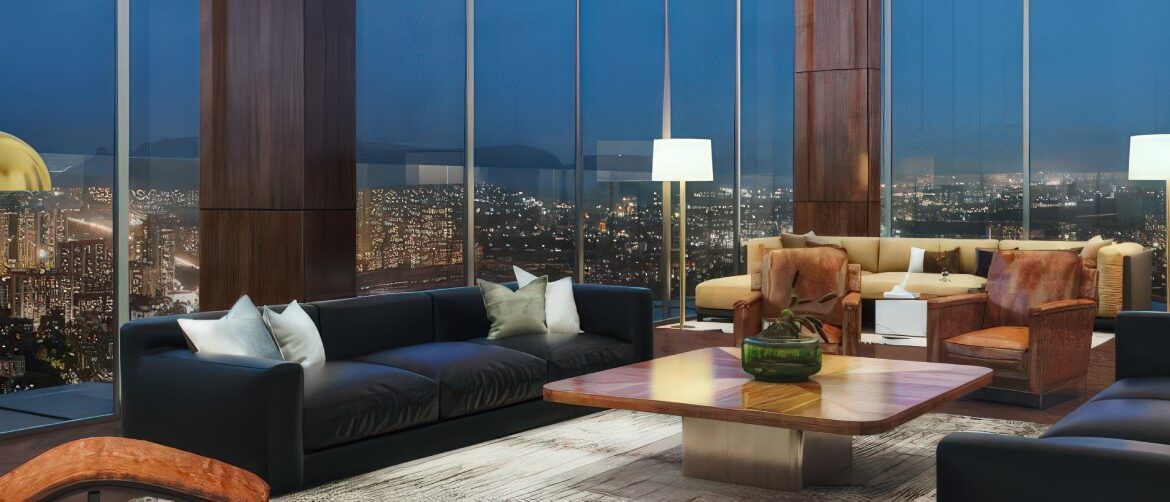
Developers have responded with remarkable acuity. Residences are conceived not as enclosed domestic spaces but as elevated experiences. Voluminous interiors framed by floor to ceiling glass dissolve the boundary between inhabitant and horizon. Private elevators ensure discretion, while sky decks and temperature-controlled pools transform leisure into spectacle.
Landmark developments such as World One and The Camellias articulate this ethos with particular clarity. They do not simply offer homes. They offer vantage points from which the city itself becomes a possession.
Capital, Scarcity, and the Allure of Height
The ascent of vertical luxury is underpinned by a compelling economic logic. In India’s premier urban centres, land has acquired an almost mythical scarcity. Horizontal expansion is constrained, both by geography and by regulation. Verticality, therefore, emerges as inevitability as much as innovation.
Yet economics alone cannot account for the fervour surrounding these residences. There exists, among India’s high net worth individuals, an increasingly discernible desire for visibility. Real estate has evolved into a declarative medium, an articulation of identity rendered in concrete and glass. To reside in a tower of renown is to participate in a narrative of success that is at once personal and public.
These developments function as self-contained realms of privilege. Within their confines, one encounters private clubs, wellness sanctuaries, curated retail, and concierge services of exceptional refinement. The external city becomes almost incidental. Life unfolds within a carefully orchestrated ecosystem where convenience and exclusivity are inextricably entwined.
 Engineering the Impossible, Refining the Invisible
Such edifices are not merely aesthetic triumphs. They are feats of formidable engineering. To build at such heights within the varied climatic and seismic conditions of the Indian subcontinent demands both ingenuity and precision.
Advancements in structural systems, from tuned mass dampers to high performance façades, ensure that these towers possess both resilience and grace. The experience of inhabiting them is deliberately seamless. The complexities of their construction are rendered invisible, allowing residents to engage only with the refinement they embody.
A noteworthy evolution lies in the integration of environmental consciousness. Sky gardens introduce moments of verdure amidst the vertical expanse. Energy efficient systems and water conservation measures are increasingly embedded within design philosophies. Luxury, in its most contemporary articulation, is beginning to accommodate responsibility.
The Vertical Society
Beyond architecture and economics, these towers are quietly reshaping the social fabric of urban life. They cultivate a form of proximity that is at once intimate and exclusive. Residents, often drawn from analogous spheres of influence, inhabit a shared vertical milieu.
Encounters unfold within sky lounges, private cinemas, and landscaped terraces suspended far above the ground. Community is not incidental, it is curated. Privacy remains paramount, yet belonging is subtly engineered through shared spaces and experiences.
In this respect, India’s evolving skyline finds resonance with global capitals such as New York City and Dubai, where vertical luxury has long been synonymous with metropolitan sophistication.
Between Elevation and Exclusion
Yet, for all its splendour, this vertical ascent invites reflection. Towers that rise in splendour inevitably cast shadows that extend beyond the architectural. In cities where questions of housing affordability persist with urgency, the proliferation of ultra luxury residences introduces a striking juxtaposition.
The skyline, viewed in its entirety, becomes a narrative of contrast. Opulence and scarcity coexist in uneasy proximity. The ascent of a privileged few is set against the grounded realities of many. It is a reminder that progress, when uneven, acquires a certain dissonance.
A Future Written in the Sky
The trajectory, however, remains unmistakably upward. As urbanisation accelerates and ambition deepens, vertical living is poised to define the next chapter of India’s luxury narrative.
The future promises an even more seamless synthesis of technology, sustainability, and design. Intelligent homes that anticipate their inhabitants, structures that generate their own energy, and environments that dissolve the distinction between interior and exterior will shape what lies ahead.
To dwell above the city is no longer simply to escape it. It is to reinterpret it. In these elevated sanctuaries, India’s new elite do not merely inhabit space. They command perspective. And in that rarefied altitude, they find not just residence, but revelation.