

Behind every iconic skyline lies a system built on discipline, not chance.
This is where labour, trust, and leadership quietly hold everything together.
Before the city gathers pace each morning, construction sites are already in motion. Steel rises, concrete settles, and labour begins long before recognition arrives. It is here, within this relentless rhythm of execution, that the foundations of modern urban life are laid. As Labour Day approaches, the focus shifts from finished skylines to the invisible systems, people, and discipline that make them possible.
Construction is often judged by what is visible. Towers define ambition, façades signal progress, and scale becomes a measure of success. What remains largely unseen is the structure behind the structure, driven by labour, precision, and accountability. Workers operate in demanding environments where accuracy is non-negotiable and error carries consequence. Every stage is interlinked, and every decision has structural weight.
 For Narinder Mohan Mittal, Director Projects at GB Realty, this understanding is the result of more than three decades in construction. “I had my education in Chandigarh,” he says. His professional journey began in Faridabad and extended across Gurgaon, Delhi, and the NCR before bringing him back. “It is kind of my hometown. My family and extended family live in Panchkula. I am now based in New Chandigarh.”
His early exposure shaped his direction. “When I did my engineering and started my professional journey, I was exposed to various fields, from project management to construction management. I found myself gelling into these areas very well. It has always been of interest to me, and it will remain so.”
Today, his role has evolved into one of guidance and oversight. With his children settled in Bangalore, he reflects on a phase defined by mentorship. “I am at a stage where I can mentor people, guide projects to fruition in a manner that is quality conscious and timely, where everything follows a planned process. I am enjoying my professional as well as my personal journey.”
His experience spans multiple dimensions. “You get experience in various fields,” he explains. “It is site, it is core office, it is construction techniques, aspects like tendering and contracting, timeline planning, tracking, monitoring, handling teams, mentoring teams, looking after multiple sites, and taking them from start to finish. Over time, every organisation has a different setup and way of working, and you learn different ways of dealing with people and professional responsibilities.”
He sees growth as continuous. “You evolve over a period of time. The journey of life is a process, not a destination. You keep learning along the way. Technology is changing fast, the environment is dynamic, and every day you have something new to learn. One is never perfect. Even after years of experience, you remain on a learning curve.”
That perspective defines his approach to the field itself. “Construction is a vast field. It has many facets, concept planning, detailed planning, tendering, contracting, budgeting, execution, and people management. It is like multiple disciplines combined into one. You never feel bored. It is dynamic and you enjoy the journey.”
Yet, beneath that dynamism lies discipline. “Construction is not just execution. It is discipline. Every stage is connected. If one part fails, the entire structure is affected,” he says.
When asked about a reality often acknowledged but rarely admitted, the temptation to cut corners under pressure, his response is unequivocal. “In daily work, such situations arise. Cutting corners may have a short-term benefit, but in the long term it has repercussions. I try to be proactive so that such situations do not arise. If they do, I evaluate the impact. For long-term quality and to avoid discomfort to residents, it is always better not to cut corners.”

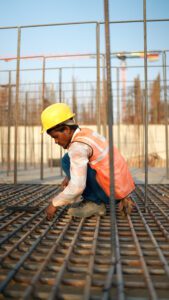
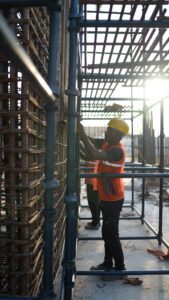
This discipline extends to labour practices as well. “Trust starts from the ground level workers,” Mittal emphasises. “If they do not trust the system, nothing works. We build that bond so they can speak up freely. That is how problems are prevented.” He adds, “All workers on site are above eighteen. We ensure that.”
In the context of Labour Day, when asked about child labour, he explains, “Our operations are contractor-based, but our agreements clearly prohibit child labour. If children are present, they are kept in a crèche and looked after. On our sites, all workers are above eighteen and skilled.”
Communication forms the backbone of this system. “If there is trust, two-way communication, and participative decision making, things work well. Not everyone is comfortable speaking, so non-retaliation policies are important. People must feel safe to raise concerns.” He adds, “Suggestions are encouraged, and contributions are recognised and rewarded.”
Safety, he insists, is built into the system. “It is IGBC certified for a reason,” he says, referring to Indian Green Building Council standards. “It is iconic as well. When you build at that level, you cannot compromise.”
At the structural level, safety begins from the base. “The foundation is critical. If the base is not right, nothing above it will hold.” Routine vigilance is equally important. “During site visits, you identify risks. For example, during excavation, rainfall can cause soil collapse. You must support and retain the soil through proper shoring. These are unseen decisions, but they save lives.”
He reinforces that safety lies in what is not visible. “People see the building, but not what keeps it safe.” On overlooked faults, he is direct. “It depends on your mindset. You cannot ignore hazards. If a crane is moving loads over people, or material falls from height, these are serious risks. Ignorance leads to accidents, and accidents can be fatal.”
Engineering resilience is embedded into design. All developments are Zone 4 earthquake-resistant. “The required safety measures are already built into the structure,” he explains. On flooding, he clarifies that maintenance is key. “Drainage systems and pumps are in place. If they are not maintained, problems arise. That is why periodic checks and standby systems exist.”
Technology strengthens this oversight. “The building operates on a BMS system. Any issue is immediately visible and can be addressed.” Material quality is equally controlled. “Materials are tested in-house and by third-party laboratories. Whether steel or concrete, strict checks ensure quality and safety.”
Sustainability, he emphasises, is not symbolic. “Being IGBC certified is not just a badge. Teams are trained through workshops, covering dust mitigation, PPE, and environmental practices. Initially there may be resistance, but once understood, these practices are accepted.”
He explains that iconic buildings are defined by more than height. “They must meet parameters such as road width, height, design distinction, and environmental integration.” Referring to OPUS 1, he notes, “It is IGBC Platinum certified and one of its kind in New Chandigarh. That requires greater effort from design to execution.”
Even after three decades, learning remains constant. “Every day you learn something new. There are new challenges. If someone thinks they have reached the pinnacle, they are no longer learning. You must remain on that curve.”
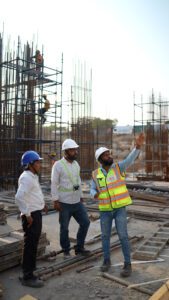
Execution partners, too, reflect this philosophy. When asked about Suryacon, he states, “They are a reputed contractor with extensive experience. We have chosen the best.”
On materials, the approach remains uncompromising. “Everything is tested rigorously to ensure the structure is strong, safe, and durable.”
When asked for a final message to residents and future occupants, his response is simple yet assured. “They are in safe hands. They will be assured of quality and they will get what they expect. We will deliver our best.”
As cities continue to expand, construction remains central to transformation. Yet beneath every structure lies a narrative rarely seen in full, one of labour, discipline, trust, and responsibility.
This Labour Day, the focus returns to that foundation. Not to the skyline, but to what holds it together.