
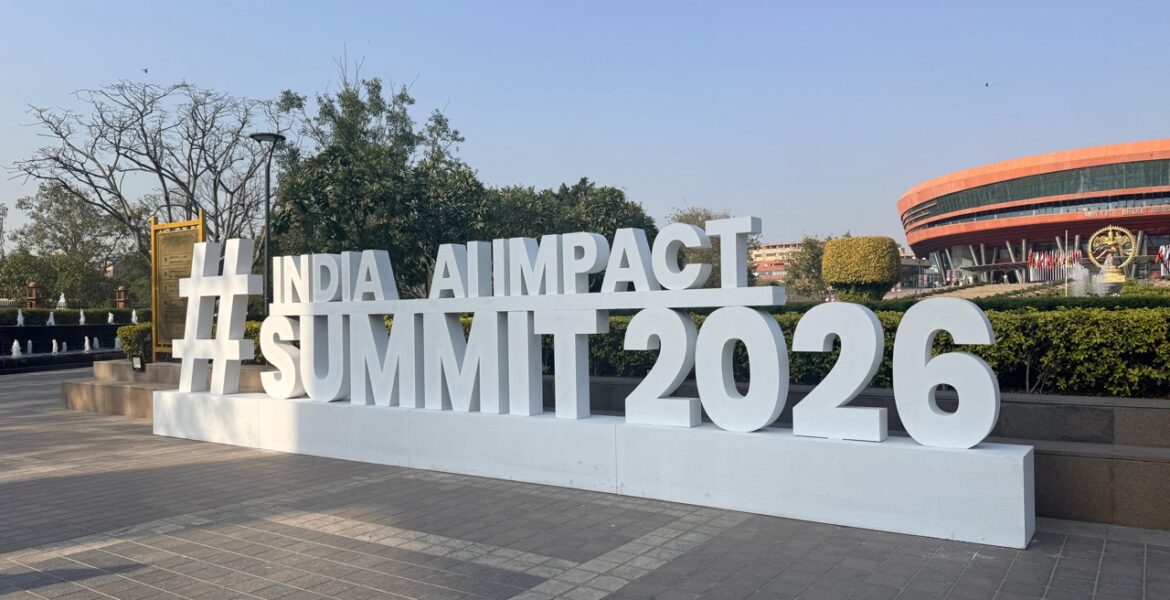
From 16 to 20 February 2026, the imposing expanse of Bharat Mandapam became the locus of a dialogue that may well define the intellectual architecture of the coming decade. The India AI Impact Summit 2026 was, ostensibly, a global congregation devoted to artificial intelligence. In substance, however, it was a meditation on power, responsibility and the moral cadence of technological acceleration. The GB team had the distinct privilege of attending the summit, and the experience was, in every respect, nothing short of fabulous. It was immersive without being theatrical, visionary without lapsing into utopian excess.
 What rendered the summit extraordinary was not merely the presence of global technology leaders and policymakers, but the palpable shift in tone. Artificial intelligence was no longer being presented as an abstract frontier of innovation; it was being examined as an infrastructural force already embedded within healthcare systems, financial architectures, agricultural analytics and governance frameworks. Conversations resonated with gravity. As one delegate observed in a closed discussion, “The question is no longer what AI can build, but what it might quietly rebuild without us noticing.”
Among the most compelling experiences for the GB delegation was the health technology showcase curated by Reliance Jio. The pavilion demonstrated AI-assisted diagnostics, predictive health modelling and integrated patient data ecosystems with remarkable clarity and sophistication. Far from being speculative prototypes, these systems appeared deployable and scalable. One member of the GB team, Jitesh Bansal remarked, “This is not the future of healthcare; it is the imminent present.” The seamless fusion of data analytics with clinical insight illustrated how artificial intelligence can recalibrate access to quality healthcare, particularly in regions historically constrained by infrastructure.
Equally arresting were the three-dimensional holographic installations dispersed across the exhibition halls. These were not decorative embellishments but dynamic digital messages suspended in luminous clarity. Reflecting upon this innovation, Jitesh Bansal noted, “These holograms are not displays; they are dialogues. They free communication from the confines of screens.” His observation encapsulated the broader philosophical undercurrent of the summit: technology is evolving from tool to environment. The holographic projections seemed to herald an era in which information will no longer be merely consumed but spatially inhabited.
 The aerospace segment of the summit offered another dimension of technological audacity. Advanced simulations depicted rockets equipped with AI-driven induction systems capable of autonomous recalibration mid-trajectory. The integration of propulsion mechanics with real-time data analytics signified a new paradigm in aerospace resilience. During a technical exchange, Dr Joginder Singh articulated a perspective that resonated deeply: “Even if a rocket were to crash, the integrated data architecture ensures that intelligence survives impact.” His words transcended the literal context of aerospace engineering. They underscored a broader ethos emerging at the summit, that in an age defined by data, durability lies not merely in hardware, but in the preservation and sovereignty of information.
The presence of global technology leaders such as Sundar Pichai and Sam Altman further elevated the discourse. Their interventions were marked by caution as much as ambition. Artificial intelligence, they acknowledged, now intersects with employment structures, democratic processes and national security architectures. The rhetorical exuberance that once characterised AI discussions has matured into circumspection. There was an implicit consensus that innovation divorced from ethical stewardship risks eroding public trust.
In his keynote address, Narendra Modi articulated a doctrine of human-centric innovation. He affirmed that technology must remain accountable to societal welfare, asserting that India seeks not merely to adopt artificial intelligence but to participate meaningfully in shaping its global governance. The unveiling of the Delhi Declaration further reinforced this aspiration, advocating transparency, accountability and collaborative oversight across nations of varying technological maturity.
 As the summit concluded, the sentiment within the GB delegation was reflective rather than celebratory. The experience had been fabulous not solely because of its technological spectacle, but because of its intellectual sincerity. It illuminated both the promise and the precariousness of artificial intelligence. February 2026 may ultimately be remembered as a moment when the global community paused to consider not just the velocity of innovation, but its vector. Intelligence had indeed met intent, and for five consequential days in New Delhi, the world appeared committed to ensuring that the former would be guided by the latter.