

The morning had barely broken when Ramesh stepped onto the half-finished slab, the city still wrapped in a pale, uncertain light. There is a peculiar stillness that lingers at construction sites before the day begins in earnest, a silence punctuated only by the distant hum of traffic and the faint clatter of tools being unpacked. For a fleeting moment, the skeletal structure around him seemed almost contemplative, as though it too understood the labour it demanded and the lives it quietly consumed.
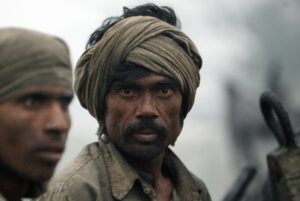 Ramesh adjusted the faded cloth wrapped around his head, a habitual gesture against dust and sun, and looked down from the fifteenth floor. From that height, the city appeared ordered, almost composed. Roads aligned neatly, buildings stood in quiet symmetry, and life below seemed deceptively contained. Yet, he knew better. He knew that beneath this illusion of order lay a relentless machinery of effort, of which he was an inseparable, invisible part.
He had arrived in the city seven years ago from a small village in eastern Uttar Pradesh, carrying little more than a bag of clothes and the weight of expectation. The land back home had grown increasingly unyielding, its yield insufficient to sustain a growing family. Migration was not a choice. It was an inevitability shaped by circumstance, one that millions like him had accepted without ceremony.
Construction work, he was told, would be steady. It would offer daily wages, a semblance of continuity. What he was not told was the cost at which that continuity would come.
By six o’clock, the site had awakened. The stillness gave way to a rising cacophony of machinery, shouted instructions, and the rhythmic clang of metal against metal. Men and women began to arrive in groups, some with children in tow, others alone, their expressions already set in a quiet resignation. There was no grand commencement to their day. No formal beginning. Labour simply began, as though it had never truly ceased.
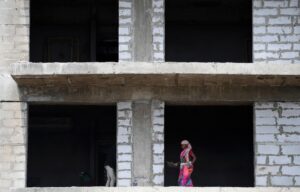 Among them was Meena, a woman in her early thirties, though the lines on her face suggested a life far older. She balanced a shallow metal pan filled with gravel on her head with an ease that spoke of long familiarity. Her movements were precise, almost measured, as she navigated the uneven terrain of the site.
“I used to be afraid of heights,” she had once said, half-smiling, when asked how she managed to work on upper floors. “Now, I am afraid of stopping.”
Her words c
arried a quiet truth that few outside this world would fully comprehend. For workers like Meena, fear is not an abstract emotion. It is a daily negotiation. The fear of falling, of injury, of withheld wages, of illness without recourse. Yet, above all, there is the fear of unemployment, of returning to a place that can no longer sustain them.

India’s construction sector is one of the largest employers of informal labour, engaging over 50 million workers according to estimates by the International Labour Organization. It is a sector that thrives on mobility, absorbing migrants from rural regions and offering them immediate, if precarious, employment. Yet, this vast workforce remains largely unorganised, its contributions monumental yet seldom acknowledged in proportion to their significance.
The irony is stark. The very individuals who build the cities often remain excluded from them. They construct homes they will never inhabit, offices they will never enter, and infrastructures that may never directly serve them. Their relationship with the city is transient, defined by labour rather than belonging.
At the site, safety measures existed, but often as a formality rather than a guarantee. Helmets were distributed, though not always worn. Harnesses were available, though seldom enforced. The urgency of deadlines frequently overshadowed the importance of precaution.
In 2016, a tragic incident in Kolkata brought this reality into sharp focus when the Kolkata flyover collapse resulted in the loss of over two dozen lives, many of them labourers. It was a moment that briefly captured national attention, prompting discussions on safety regulations and accountability. Yet, as with many such incidents, the discourse gradually faded, while the conditions on the ground remained largely unchanged.
For workers like Ramesh, such events are not distant news. They are cautionary tales that linger in the mind, even as the body continues its routine. “You hear about it,” he once remarked, “and then you come to work the next day.”
There is a certain inevitability in that statement, a reflection of limited alternatives. For many labourers, the absence of work is a far more immediate threat than the possibility of danger.
Despite these challenges, there exists a remarkable sense of community among workers. Bonds are formed not through shared leisure, but through shared endurance. Meals are often communal, simple yet sustaining. Stories are exchanged in fragments, between tasks, offering brief moments of reprieve.

Children, too, are a constant presence on many sites. Some attend makeshift schools organised by non-profits, while others remain on the periphery, observing the rhythms of labour long before they are old enough to partake in it. Their presence is both hopeful and unsettling, a reminder of continuity that carries with it the risk of repetition.
The question of welfare remains complex. Initiatives such as the Building and Other Construction Workers’ Welfare Boards, established under the Building and Other Construction Workers Act, were designed to provide social security, including healthcare, pensions, and education assistance. However, the implementation of these measures has often been inconsistent. Registration processes are cumbersome, awareness is limited, and access remains uneven.
The result is a system where entitlements exist in principle but are not always realised in practice.
During the COVID-19 lockdown in India, the vulnerabilities of construction labourers became starkly visible. As cities shut down, work ceased almost overnight. With no income and limited support, thousands of workers embarked on arduous journeys back to their villages, often on foot, covering hundreds of kilometres. Images of these migrations captured global attention, revealing the fragility of livelihoods that had long been overlooked.
For Ramesh, that period remains etched in memory. “We built the city,” he said quietly, “but when it stopped, there was no place for us in it.”
Yet, even in the aftermath, the cycle resumed. Workers returned, sites reopened, and construction once again became a symbol of recovery. The resilience of this workforce is undeniable, though it often borders on necessity rather than choice.
There are, however, gradual shifts taking place. Conversations around worker welfare, safety standards, and fair wages are gaining prominence. Some developers have begun to invest in better living conditions at sites, providing temporary housing, sanitation facilities, and access to healthcare. Non-governmental organisations continue to play a crucial role in bridging gaps, offering education for children and advocating for workers’ rights.
Still, these efforts remain uneven, often dependent on individual initiatives rather than systemic reform.
As the day progressed, the sun climbed higher, casting a relentless glare over the site. The pace of work did not slow. Cement was mixed, bricks were laid, steel was fastened into place. Each action, repetitive yet essential, contributed to a structure that would eventually be celebrated for its design, its luxury, its innovation.
Rarely would the narrative include those who made it possible.
 By evening, exhaustion settled into the bodies of the workers, not dramatically, but as a quiet, cumulative weight. The site began to empty, tools were set aside, and the unfinished structure returned to a state of stillness. For a brief moment, it resembled its morning self, suspended between what it was and what it would become.
Ramesh lingered for a while before leaving, looking once again at the city from above. There was no sense of ownership in his gaze, nor was there resentment. There was, instead, a quiet acknowledgement. He had contributed to something larger than himself, even if his name would never be associated with it.
That is perhaps the most enduring paradox of construction labour. It is both foundational and invisible. It shapes the physical world in profound ways, yet remains largely absent from the narratives that define it.
To speak of skylines without acknowledging the hands that raise them is to tell an incomplete story. Behind every tower, every bridge, every road, lies a workforce whose labour is as essential as it is overlooked. Their stories are not always dramatic, nor are they often documented. They exist in the everyday, in the repetition of effort, in the quiet perseverance that sustains an industry.
As cities continue to expand, reaching ever higher and further, the question that lingers is not merely one of growth, but of recognition. Of whether the individuals who build our environments will continue to remain on the margins of the very spaces they create.
For now, as night descends and the city lights begin to flicker into life, construction sites across the country fall silent. But only temporarily. By dawn, the rhythm will resume. The labour will continue. And the skyline will rise, carried on the shoulders of those who remain, even in their indispensability, largely unseen.