

When Gurinder Bhatti looks at his son Gurnav, he sees reflections of himself in unexpected places. Yet the moment that fills him with the greatest pride is not hearing his son say he admires him, but hearing him say, with certainty and conviction, “I am GB only.”
There are men who announce their love loudly, and then there are men who place a water bottle on a bedside table every single night without being asked. Gurnav Bhatti is the latter kind: quiet, deliberate and precise in his care. His father, Gurinder Bhatti, did not immediately notice. That, in itself, is perhaps the most beautiful part of the story.
It began with small things. Before Mr Gurinder Bhatti retired for the night, the water bottle was already at his bedside. His phone was on charge. When they travelled together, Gurnav had packed everything, the shoes, the accessories and the little kit of things a man needs on the road, without a word passing between them.
The day the penny finally dropped, Gurinder had reached for something he thought he had left behind. Gurnav produced it from the bag before his father could finish the thought, offering only the simplest of explanations: “I know you forget.”
It was in that moment, he says, that he understood what had been happening quietly all along.
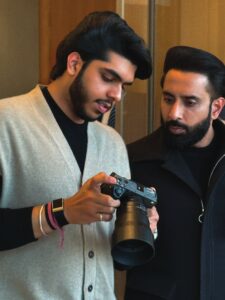 “I had always wanted someone who would look after the small things,” he reflects. “And there he was, already doing it, not because I asked, but because he knew.”
There was another moment, equally telling, that arrived not on a journey but in an ordinary room, in the middle of an ordinary conversation. Gurinder had walked in to find Gurnav sitting with his grandmother, listening with the same quality of attention that he himself had once given to the people he loved most.
When he asked his son a question, Gurnav asked him to repeat it, not out of inattention, but because he had been genuinely absorbed in the conversation. His grandmother, amused, told him not to be like his father.
And Gurnav replied, without missing a beat, “I am GB only.”
It is the sort of remark that fathers carry with them for years.
Ask GB Sir to describe his son in three words and he does not pause.
“Coloured carbon copy,” he says, with the quiet certainty of a man who has thought about this for a very long time.
He sees himself in his son, in the habits, the temperament, the values and even some of the flaws. Yet what brings him the greatest pride is not how much Gurnav resembles him, but how determined he is to become his own person.
When Gurinder Bhatti asked his son who he wished to become, the answer was never Gurinder Bhatti. It was always, simply and firmly, Gurnav Bhatti.
“I asked him once if he idolised anyone. He said yes, he idolised me. But he did not want to be me.”
He recalls his son’s words with remarkable clarity.
“He said, ‘You are you; I am me. You have only taught me that the Almighty has blessed everyone with something special and unique. I am still trying to find out what is unique in me.'”
In those few sentences, a father heard confirmation that he had done something right.
Mr Gurinder is candid about what Gurnav has inherited. The good qualities are there, and so are the less flattering ones.
“God has given him as my parallel,” he says simply.
There is no vanity in the observation, only a sense of wonder that a person can pass on not only values and beliefs, but an entire way of seeing the world, and then watch another human being shape those gifts into something uniquely their own.
Of all the lessons Gurinder tried to instil in his son, one sits at the foundation of everything else.
“Life has no past and no rebirth. It is just playing.”
Among the many things he has learned through experience, this belief remains central. For Gurinder Bhatti, life is not meant to be lived in regret or spent revisiting old wounds. What matters is the present moment, the choices we make today and the way we choose to move forward.
It is a philosophy that runs through everything else he believes, and one that would later find its fullest expression in the blessing he offers his son on Father’s Day.
The most cherished memory between father and son did not announce itself as such. It arrived at Moksha on the evening of Gurnav’s eighteenth birthday, over a glass and a long silence.
“For eighteen years, I had carried this responsibility,” Gurinder says. “That evening I realised it would never really end. But I also realised it was time to let him find his own way while I found mine.”
It was an evening of thresholds, with one chapter quietly closing and another beginning.
He ordered a drink for his son.
“It is your eighteenth birthday,” he told him. “Let us have one together today.”
What followed is recounted with a father’s unmistakable combination of amusement and tenderness.
“The way he held the glass,” Gurinder says, laughter lingering somewhere behind the words. “I asked him, ‘Is this your first drink?’ He said yes.”
He studied his son carefully, the composure, the studied nonchalance and the careful way Gurnav carried himself throughout the evening.
“I read his eyes. Five pegs in and he was perfectly normal.”
A slow smile follows.
“I was not born yesterday. But I let him have his moment.”
Then comes the memory he treasures most.
“He started his first drink in my world. On the rocks.”
For Gurinder, the significance of that evening had little to do with the drink itself. It was about something far greater: the quiet recognition that the boy sitting across from him was no longer a child.
For the first time, they sat together not simply as father and son, but as two men sharing a moment neither would ever forget.
On this Father’s Day, GB Sir’s blessing for his son is not so much a wish as a conviction, the distillation of everything he has learned about how to move through the world with grace, resilience and purpose.
“Whatever has happened, has happened,” he begins. “Let the past remain in the past. Every morning, we wake up, we freshen up, and we begin the day. We do not carry into today what belonged to yesterday. And in our bodies, we do not carry garbage. So why should we carry it in the mind?”
He pauses before continuing.
“We humans believe we think. But we only ever think about the thoughts we already have. No matter what the circumstances or the situation, the result will always be about you. What you are committed to is what will cause the result.”
And then, as though speaking directly to Gurnav across whatever distance might one day separate them, he offers the words he most wants his son to remember.
“Never give up. Keep moving. Someone lives, someone dies, someone comes, someone goes. Focus on your goals. Because when you were born, no one was with you. Everything in this world happened because of your ambition, your focus. If anyone ever leaves you, that is all right. You were always enough.”
This Father’s Day, Gurinder Bhatti’s tribute to his son is ultimately a celebration of individuality, resilience and quiet love.
Of everything he has created, nurtured and worked for, nothing has brought him greater pride than a son who knows exactly who he is, and who is still discovering who he can become.